
We are now accepting the Canadian Dental Care Plan — Learn More

Kids Dental Care in Vancouver: A Parent’s Guide From First Tooth to Teens

Dentist checking a young girl's teeth with a mirror during a kids dental care check-up while her mother watches

Short answer: Kids dental care starts early. Once the first tooth appears, brush twice a day with a rice-grain smear of fluoride toothpaste (pea-sized from age 3), book a first dental visit within six months of that tooth or by age one, keep check-ups about every six months, and ask about sealants when permanent molars arrive.

This guide walks you through what to do at each age, how much toothpaste to use, when sealants and fluoride varnish help, how to spot cavities, and how the Canadian Dental Care Plan (CDCP) and the BC Healthy Kids Program can help pay.

It comes from the team at Dentist on Kingsway, a family dental practice at 2249 Kingsway in East Vancouver that sees patients from their first tooth through to dentures.

What Is Kids Dental Care, and Do Kids Need Different Care Than Adults?

Kids dental care is the daily home routine and regular dental visits that keep a child’s baby teeth and new adult teeth healthy while the mouth is still growing. It differs from adult care in four ways.

  • Baby teeth have thinner enamel, so decay can reach deeper into the tooth faster than in an adult tooth.
  • Children need help brushing. Most kids can’t clean every tooth well on their own until roughly age eight.
  • The bite is still developing, so check-ups also watch how the jaw grows and how adult teeth come in.
  • Habits are still forming, so early visits help build brushing, flossing, and snack routines.

Baby teeth matter, even though they fall out. They help children chew, speak clearly, and hold space for the adult teeth underneath. If a baby tooth is lost early to decay, nearby teeth can drift into the gap and crowd the adult tooth coming in behind it.

When Should a Child First See a Dentist?

The Canadian Dental Association recommends a first dental assessment within six months of the first tooth appearing, or by age one. First teeth usually arrive around six months, so many first visits happen before a child’s first birthday.

The first visit is short and gentle. Its main job is to catch problems early and to show your child that the dental office is an ordinary place. At Dentist on Kingsway, a first visit covers three things:

  1. Counting your child’s teeth and looking for early signs of decay.
  2. Checking how the jaw and bite are developing.
  3. Talking with you about brushing, feeding, and soother or thumb habits.

Very young children often sit on a parent’s lap instead of in the dental chair. If your child just sits, looks at the instruments, and leaves happy, that is a successful first visit. Read more on our children’s dentistry page.

Kids Dental Care by Age: What to Do at Home and at the Dentist

Use this checklist as a starting point. Your dentist may adjust it based on your child’s risk of cavities.

AgeAt homeAt the dentist
Birth to 12 monthsWipe gums with a clean, damp cloth. Once the first tooth appears, brush twice a day with a rice-grain smear of fluoride toothpaste. No bottle of milk or juice in bed.First visit within six months of the first tooth, or by age one.
1 to 3 yearsAn adult brushes twice a day with a rice-grain smear. Lift the lip to check the gumline for white or brown spots. Offer water between meals.Regular check-ups and fluoride varnish when your dentist recommends it.
3 to 6 yearsSwitch to a pea-sized amount of toothpaste and teach spitting, not swallowing. Start flossing once teeth touch.Check-ups and cleanings, plus a chat about thumb-sucking or soother habits.
6 to 12 yearsKeep checking brushing until about age eight or later. Use a mouthguard for contact sports.Sealants on the first adult molars (around age 6) and a first orthodontic check around age 7.
12 and upTake extra care around braces or aligners, and limit sugary drinks.Sealants on the 12-year molars, with check-ups continuing.

Two habits matter at every age. First, how often teeth meet sugar matters more than how much is eaten at once, so a treat with a meal does less harm than the same treat sipped over an afternoon.

Second, regular check-ups catch small problems while they are still easy to fix. For more everyday ideas, see our 10 easy ways to prevent cavities.

How Much Fluoride Toothpaste Should Kids Use?
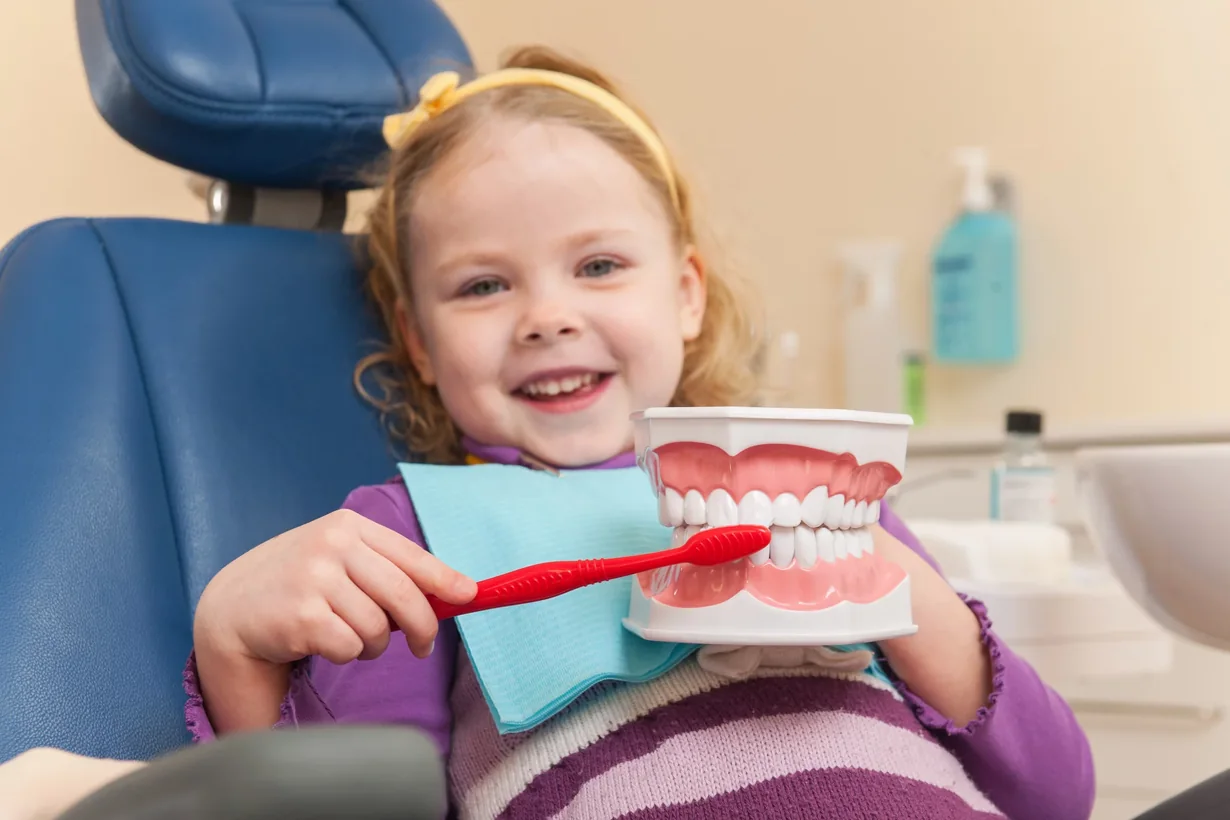
Smiling young girl in a dental chair practising brushing on a tooth model with a red toothbrush

Use a smear the size of a grain of rice for children under 3, and a pea-sized amount from age 3, according to HealthLink BC File #19 (updated December 2025). Brush twice a day with a small, soft-bristled toothbrush.

The small amount matters because young children swallow toothpaste. Too much fluoride while adult teeth are still forming under the gums can leave faint white flecks on the enamel, called dental fluorosis. It is cosmetic, and using the right amount prevents it.

  • Do the brushing for your child, then let them take over with you checking afterwards. For many kids, that handover happens around age eight.
  • Teach your child to spit out the toothpaste instead of swallowing it.

Our brushing techniques guide shows how to angle the brush and reach every surface.

Do Kids Need Dental Sealants and Fluoride Varnish?

Many children benefit from both. Sealants protect the deep grooves of the back teeth, and fluoride varnish strengthens the enamel on every tooth. Together, they are two of the simplest parts of preventive dental care for kids.

Dental sealants

A sealant is a thin coating painted into the grooves of the back molars, where most childhood decay starts. The tooth is cleaned and dried, the sealant is painted on, and a curing light hardens it. There is no drilling and no freezing, and it takes a few minutes per tooth.

The best time is soon after the adult molars come in, usually around age 6 for the first molars and around age 12 for the second molars. Sealants commonly last five to ten years, and your dentist checks them at each visit. Learn more on our dental sealants page.

Fluoride varnish

Fluoride varnish is a high-strength fluoride painted onto the teeth at a check-up. It takes under a minute, with no trays to hold in the mouth, and it can help reverse very early decay (chalky white spots) before a cavity forms. See our fluoride treatment page for aftercare tips.

Planning your child’s first visit or next check-up?

What Are the Signs of Cavities in Kids?

Cavities in kids often start as chalky white spots along the gumline, then turn brown or dark as they grow. Watch for these signs:

  • White, brown, or dark spots on the teeth
  • Sensitivity to cold, sweets, or chewing
  • Complaints of toothache, or avoiding certain foods
  • Swelling or a bump on the gums near a tooth

Dark, broken-down baby teeth (what some parents call “rotten teeth”) mean the decay has gone deep. That needs treatment, not waiting, because it can lead to pain, infection, and trouble eating or sleeping. A common cause in toddlers is going to bed with a bottle of milk or juice.

Small cavities can often be fixed with tooth-coloured fillings. If a baby tooth has to come out early, a space maintainer can hold room for the adult tooth. Our tooth decay treatment page explains the options.

How Can You Prepare Your Child for a Dental Visit?

Keep it calm, simple, and ordinary. Children pick up on how adults feel, so your tone matters more than any promise.

  1. Book a morning visit when your child is rested and fed.
  2. Read a picture book about going to the dentist in the days before.
  3. Use neutral words. Avoid “hurt,” “needle,” or “drill,” even when you are trying to reassure.
  4. Skip the bribe. Promising a treat for being brave signals that something scary is coming.
  5. Share sensory or developmental needs with the office before the visit.
  6. Stay relaxed yourself. If you feel nervous about dentists, say so, so the team can work around it.

At Dentist on Kingsway, the team uses a tell-show-do approach: explain each step in plain words, let your child see and touch the instrument, then use it. They go at your child’s pace and stop when your child asks. For sensory needs, the office can arrange a quieter time, a no-treatment practice visit, and softer lighting and noise.

Pediatric Dentist or Family Dentist: Who Should See Your Child?

For most children, a family dentist is the right fit. Check-ups, cleanings, fluoride varnish, sealants, and small fillings are everyday work in a general family practice.

A pediatric dentist is a dentist who has completed extra specialty training in children’s dentistry after dental school and is certified as a specialist. Families usually see one when a child has complex medical needs or needs extensive treatment, often after a referral from their family dentist.

Smiling parents and their young daughter in the dental chair giving a thumbs up beside a dental team member

When you are choosing a dentist for kids, a family practice has some practical advantages:

  • One office and one set of records for the whole family
  • Back-to-back appointments, so one trip covers parents and kids
  • A team that knows your family’s history, such as an older sibling’s crowding
  • A familiar room, since kids who watch a parent’s calm check-up see visits as normal

Dentist on Kingsway is a general family practice that sees children as part of the whole family. See our family dentistry page for care at every age.


Does CDCP Cover Dental Care for Kids in BC?

Yes, if your family qualifies. The Canadian Dental Care Plan covers children when the family has no access to dental insurance and an adjusted family net income under $90,000. You and your spouse or partner must have filed your taxes, and you apply for your children as dependants on your own application.

What you pay depends on income, according to Canada.ca (page updated August 2026):

  • Under $70,000: no co-payment
  • $70,000 to $79,999: 40% co-payment
  • $80,000 to $89,999: 60% co-payment

Preventive care, including cleanings, fluoride, and sealants, is covered. Orthodontic treatment is not currently covered. An office may also charge the difference when its fee is higher than the CDCP fee, so ask for an estimate first.

BC Healthy Kids Program

This provincial program covers basic dental care for children under 19, such as exams, X-rays, cleanings, fillings, and extractions, up to a two-year dollar limit. Children qualify through the family’s MSP supplementary benefits (generally an adjusted net income under $42,000), with no separate application. Orthodontics are not covered.

The two programs can be combined, according to the Province of BC. The dental office bills CDCP first, and Healthy Kids may cover part of what is left. The program doesn’t keep a list of participating dentists, so confirm with the office before treatment.

Private insurance and estimates

Dentist on Kingsway bills CDCP and private insurers directly, so you pay only the difference at your visit, and you get a written estimate before any treatment beyond a routine visit. Our Canadian Dental Care Plan page and our CDCP guide for BC walk through applying and what is covered.

What Counts as Urgent Kids Dental Care?

Call the dentist the same day for a knocked-out adult tooth, or for a toothache with facial swelling or a fever. Swelling and fever can mean infection, and children can get worse faster than adults.

  • Knocked-out adult tooth: hold it by the crown, never the root, keep it in milk, and call right away.
  • Knocked-out baby tooth: never put it back in, because that can damage the adult tooth underneath. Call so the dentist can check.
  • Chipped or broken tooth: save any pieces, and call promptly if there is sharp pain or pink or red showing at the break.

Our emergency dentist page explains what to do next.

Kids Dental Care at Dentist on Kingsway

Dentist on Kingsway is a family dental practice at 2249 Kingsway in East Vancouver, led by Dr. Harpreet Dhillon, with Dr. Annie Wu and Dr. Patel. The team sees every age, so parents and kids can be cared for in one place.

The office is open Tuesday to Saturday, with Thursday evenings until 7 PM and Saturdays from 9 AM to 4 PM. Many families choose those slots to avoid missed class, and the office can usually provide a school note. To book, call (604) 558-2442.

Frequently Asked Questions

What age should my child first go to the dentist?

Within six months of the first tooth appearing, or by age one, as the Canadian Dental Association recommends. Early visits are short and focus on prevention.

How often should kids see the dentist?

Most children need a check-up and cleaning about every six months. Your dentist may suggest more frequent visits if your child has a higher risk of cavities.

How much toothpaste should a toddler use?

Use a smear the size of a grain of rice for children under 3, and a pea-sized amount from age 3. An adult should do the brushing for toddlers.

Are dental sealants safe for kids?

Yes. Sealants are painted on without drilling or freezing, take a few minutes per tooth, and are checked at each visit. If you have questions about the material, such as BPA, ask your dentist before treatment.

Does CDCP cover dental care for kids?

Yes, when the family has no access to dental insurance and an adjusted family net income under $90,000. Families under $70,000 pay no co-payment, and higher bands pay 40% or 60% of CDCP fees.

What is the BC Healthy Kids Program?

It is a provincial program that pays for basic dental care, such as exams, X-rays, cleanings, fillings, and extractions, for children under 19 in families with MSP supplementary benefits. It can be combined with CDCP.

Should cavities in baby teeth be filled?

Usually, yes. Untreated decay can cause pain and infection, and losing a baby tooth early can let nearby teeth drift and crowd the adult tooth. Small cavities can often be fixed with a tooth-coloured filling.

When should my child have an orthodontic check?

A first orthodontic check around age 7 helps spot bite problems early, and it doesn’t mean treatment starts then. CDCP does not currently cover orthodontic treatment.

On this page

Book Your Visit

Have a question about this topic? Our team is happy to help.

or call (604) 558-2442

Related guides