The question we hear most often at Dentist on Kingsway is a simple one: which is better, Invisalign or traditional braces? Both straighten teeth reliably, and both have been doing it for decades. The honest answer is that the better option is the one that matches your case, your budget and your daily routine. Here is a straight comparison of Invisalign vs braces, written to help you walk into your consultation already knowing which questions to ask.

The Short Answer
If you have mild to moderate crowding or spacing and you want something discreet and removable, Invisalign is usually the better fit. If you have a complex bite problem, severe crowding, or teeth that need significant rotation, traditional braces still give the more predictable result. Teens and adults who know they will struggle to wear aligners 20 to 22 hours a day are often better served by braces, simply because braces do not depend on remembering to put anything back in.
At our Kingsway clinic, most patients turn out to be candidates for both. When that happens, case complexity and personal preference become the deciding factors, not one system being universally superior to the other.
Quick Comparison
| Feature | Invisalign (Clear Aligners) | Traditional Braces |
| Average cost | $3,000 – $8,000 | $2,500 – $7,500 |
| Treatment time | 6 – 18 months | 18 – 36 months |
| Appearance | Nearly invisible | Visible (metal or clear braces) |
| Removable | Yes | No |
| Best for | Mild to moderate cases | Complex orthodontic treatment |
| Office visits | Every 6 – 8 weeks | Every 4 – 6 weeks |
| Depends on your compliance | Yes — 20 to 22 hours a day | No — fixed in place |
| Food restrictions | None (trays come out) | Yes — hard and sticky foods |
| Retainer needed afterwards | Yes | Yes |
What Is Invisalign Treatment?
Invisalign treatment uses a series of custom-fitted clear aligners made from medical-grade thermoplastic. Each aligner is worn for roughly one to two weeks, and every new set moves your teeth a fraction closer to their final position. The trays come out for eating, brushing and the occasional special occasion, but they need to be in your mouth 20 to 22 hours a day for the plan to stay on schedule.
Treatment usually begins with a 3D scan rather than a tray of impression putty. That scan is used to map every planned movement in advance, which is why you can often see a projected outcome before you agree to anything. Small tooth-coloured attachments are sometimes bonded to a few teeth to give the aligners something to grip — they are removed at the end of treatment.
What Are Traditional Braces?
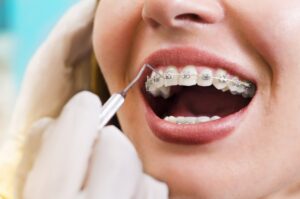
With traditional braces, a bracket is bonded to each tooth and connected by an archwire. Your dentist or orthodontist adjusts that wire at regular appointments, and the wire does the work of moving teeth into position. Braces have changed a great deal: today’s brackets are smaller and more comfortable than the ones most adults remember from their own school years, and ceramic or clear brackets are a common choice for patients who would rather not have visible metal.
Because braces are fixed in place, they work continuously without any effort from you. That is their single biggest practical advantage, and it is the reason they remain the default recommendation for younger patients and for complicated cases.
Is Invisalign Better Than Braces?
Not universally — and any clinic that tells you otherwise is selling rather than diagnosing. Invisalign is better on appearance, comfort and convenience. Braces are better on predictability in complex cases and on removing compliance from the equation entirely.
Where the two genuinely differ is control. An archwire applies continuous force in three dimensions and can be bent to do very specific things. Aligners apply force in planned increments and rely on the trays seating fully against every tooth. For straightforward movements that distinction rarely matters. For a tooth that needs to be rotated substantially, uprighted, or moved a long distance through bone, it matters a lot.
The practical takeaway: judge the two systems against your own case, not against each other in the abstract.
What Invisalign Can and Can’t Fix
Clear aligners have taken on cases that used to be braces-only, but the boundaries are still real. As a general guide:
- Usually well suited to aligners — mild to moderate crowding, spacing and gaps, mild relapse after previous orthodontic work, and minor bite refinement.
- Often possible, but case-dependent — moderate overbite or deep bite, mild to moderate crossbite, and open bite. These frequently work with aligners, sometimes with attachments or elastics.
- Usually better with braces — severe crowding, large gaps requiring substantial tooth movement, significant rotations, skeletal bite discrepancies, and cases where teeth need to be moved a considerable distance.
This is exactly the kind of judgement that cannot be made from a photograph or an online quiz. A scan and a clinical exam will tell you in one appointment which category you fall into.
Invisalign Cost vs. Braces Cost
Invisalign cost in Vancouver typically runs slightly higher than braces cost because of the 3D scanning, lab fees and tray production involved. That gap has narrowed considerably in recent years, and for many straightforward cases the two are now close enough that price is no longer the deciding factor.
What actually changes the price
- Case complexity — the number of aligners or the months in braces you need is the single biggest driver of cost.
- Treatment length — longer plans mean more trays or more adjustment appointments.
- Whether refinements are needed — a second short round of aligners at the end is common and should be quoted up front.
- Retainers — budget for these in both systems, along with eventual replacements.
Most extended health plans include a lifetime orthodontic maximum that applies to either treatment, and it is worth checking that figure before you decide. At Dentist on Kingsway we offer flexible payment plans and direct insurance billing, and we will give you the exact figure for your own case in writing before you commit to anything.
Treatment Time: Which Is Faster?
Invisalign is often quicker — typically 6 to 18 months — largely because it is used for less complex cases in the first place. Traditional braces generally run 18 months to 3 years, but they handle problems that aligners struggle with, such as major rotations or significant bite correction.
Two things stretch a timeline more than the choice of system. The first is compliance: every hour an aligner spends out of your mouth is an hour of treatment that did not happen, and a few weeks of inconsistent wear can add months to the plan. The second is biology — teeth move through bone at their own pace, and that pace varies from person to person.
Faster is not automatically better. The right timeline is the one that produces a stable result you keep.
Comfort and Daily Life
Clear aligners win comfortably on day-to-day convenience. You can:
- Eat anything — just remove the trays
- Brush and floss normally — no special tools needed
- Play sports or instruments without bracket discomfort
The biggest Invisalign benefits are flexibility and aesthetics. The main benefit of braces, by contrast, is built-in compliance: you cannot forget to wear them. If you already know that a 22-hour-a-day habit will be a struggle, that is one of the strongest arguments in the pros and cons of braces, and it deserves an honest answer rather than an optimistic one.
Does it hurt?
Neither option is painful in the way patients tend to fear, but both involve pressure. With aligners, expect a day or two of tightness each time you change trays. With braces, expect a similar period of soreness after each adjustment, plus some initial irritation of the cheeks and lips until the tissue adapts — orthodontic wax handles most of that. Over-the-counter pain relief is generally more than sufficient for either, and the discomfort eases as treatment progresses.
Keeping Your Teeth Clean During Treatment
This is the part of the comparison that gets skipped most often, and it has real consequences. Brackets and wires create surfaces that trap plaque, and patients who do not keep on top of cleaning can finish treatment with straight teeth and permanent white marks on the enamel where plaque sat against the tooth. Careful brushing, floss threaders or a water flosser, and regular professional cleanings prevent this — but braces genuinely demand more of you here.
Aligners avoid that particular risk because they come out. They introduce a different one: anything other than water should be consumed with the trays out, and teeth should be brushed before the trays go back in. Sipping coffee or juice with aligners in traps sugar and acid directly against the enamel for hours. The trays themselves also need daily cleaning, which our Invisalign care guide covers in detail.
Braces vs Clear Aligners: Which Gives Better Results?
Both work, when matched to the right case. Clear aligners versus traditional braces is no longer a black-and-white debate, and Invisalign now treats cases that would once have required brackets. For severe crowding, large gaps or teeth needing substantial rotation, however, traditional braces still deliver the more predictable outcome.
Our team maps your case with 3D imaging before recommending either option, so you can see the projected result and understand the trade-offs before you decide. If your case sits in the grey area between the two, we will tell you that as well.
Retainers: What Happens After Treatment
Whichever route you take, treatment does not end when the braces come off or the last aligner comes out. Teeth have a natural tendency to drift back toward where they started, and a retainer is what prevents that. This applies equally to both systems — there is no version of orthodontic treatment where the result maintains itself.
Retainers are typically worn full-time for a period after treatment, then reduced to nights indefinitely. Factor them into your plan and your budget from the beginning, and treat replacing a lost one as urgent rather than optional. Most relapse cases we see are simply retainers that quietly stopped being worn.
Invisalign vs Braces for Teens
For teenagers the decision usually comes down to temperament rather than dentition. Invisalign Teen includes wear indicators and replacement aligners for the ones that inevitably go missing, and it works well for organised teens who keep the trays in. For a teenager who is likely to forget — or to leave the trays in a school cafeteria — braces remove the problem entirely by staying put.
There is also a timing factor. Adolescent treatment sometimes needs to work around teeth that are still erupting, and a fixed appliance can be easier to adapt as that happens. This is worth raising directly at the consultation.
Which One Is Right for You?
Choose clear aligners if you:
- Have a mild-to-moderate teeth alignment issue
- Want a discreet option for work or social settings
- Are disciplined about wearing the trays consistently
- Prefer fewer dietary restrictions
Choose traditional braces if you:
- Have a complex bite or significant crowding
- Want a “set it and forget it” treatment
- Are looking for the most cost-effective fixed option
- Are a younger teen who may forget to wear aligners
What Happens at Your Consultation
A first orthodontic assessment at our Kingsway clinic is straightforward and takes about an hour:
- A clinical exam of your teeth, bite and gum health — gum disease and untreated decay need to be dealt with before any tooth movement begins.
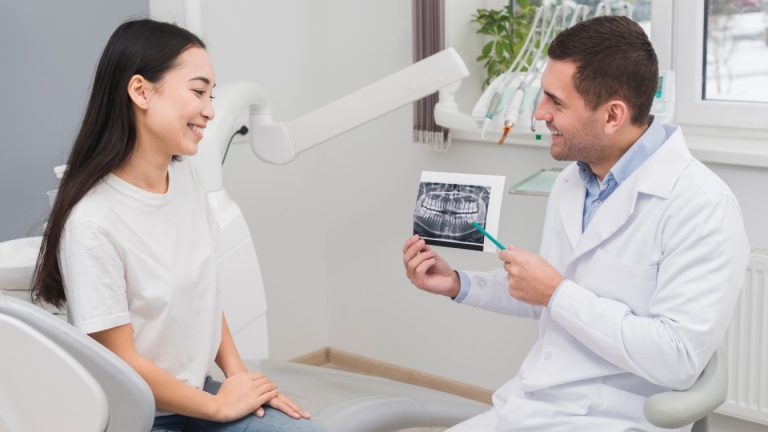
- A 3D digital scan, plus X-rays where they are needed to see root position and bone.
- A discussion of which options your case actually qualifies for, including the ones we would not recommend and why.
- A written estimate covering treatment, refinements and retainers, along with what your insurance is likely to cover.
You are not committing to anything by having the assessment done. Plenty of patients come in expecting one option and leave having chosen the other, which is rather the point of getting it examined properly. You can see the full range of our orthodontic services if you would like an overview first.
Book Your Free Consultation at Dentist on Kingsway
The only reliable way to know which option fits your smile is a one-on-one assessment. Our team will scan your teeth, walk you through both treatment plans, and give you a transparent Invisalign cost and braces cost quote — no pressure, no surprises.
Call us or book online to schedule your free Invisalign vs braces consultation at Dentist on Kingsway today. Your smile makeover starts with a conversation.
Frequently Asked Questions
1. Is Invisalign as effective as braces?
For mild-to-moderate cases, yes. For complex bite problems, significant rotations or severe crowding, traditional braces still produce more predictable results.
2. Does Invisalign hurt less than braces?
Most patients report less soreness with clear aligners, because there are no brackets or wires to irritate the cheeks and gums. Both involve a day or two of pressure after each tray change or wire adjustment.
3. Can I switch from braces to clear aligners mid-treatment?
Sometimes — it depends on how far along you are and what movements are still outstanding. Book a consultation and we will tell you honestly whether switching makes sense in your case.
4. Which option is better for teens?
Invisalign Teen works well for responsible teenagers who can keep the trays in for 20 to 22 hours a day. For a teen likely to forget, braces are the easier choice because they stay in place on their own.
5. Is Invisalign more expensive than braces?
Usually slightly, though the gap has narrowed. Invisalign typically runs $3,000 to $8,000 and braces $2,500 to $7,500, with case complexity — not the system itself — driving most of the difference. Extended health plans generally apply their orthodontic maximum to either.
6. How long does each treatment take?
Invisalign usually takes 6 to 18 months and braces 18 to 36 months, but those ranges reflect the kinds of cases each is used for. Consistent aligner wear is the single biggest factor in staying on schedule.
7. Can Invisalign fix an overbite?
Often, yes. Mild to moderate overbites are routinely treated with aligners, sometimes combined with attachments or elastics. Skeletal bite discrepancies are a different matter and may need braces or a referral.
8. Do I need a retainer after either treatment?
Yes, with both. Teeth drift back toward their original position without one, so retainers are worn full-time for a period after treatment and then nightly long-term.
Keep Reading