We are now accepting the Canadian Dental Care Plan — Learn More

Canadian Dental Care Plan (CDCP): What’s Covered & How to Use It in BC

Family reviewing what the Canadian Dental Care Plan in BC covers with a dental team member

If you don’t have dental benefits through work, the Canadian Dental Care Plan in BC may help cover the cost of your care. The plan is open to eligible residents of any age, and it covers much more than checkups, but a few of its rules catch people by surprise.

This guide explains who qualifies, what CDCP coverage includes, why you might still get a bill, and how to apply, renew, and use your coverage, based on current Government of Canada information. At Dentist on Kingsway, we accept the Canadian Dental Care Plan (CDCP) and bill it directly, so you pay only whatever is left.

What Is the Canadian Dental Care Plan?

The CDCP is a federal program that helps make dental care more affordable for Canadian residents who don’t have access to dental insurance. The Government of Canada runs the plan, and Sun Life handles claims and member cards on its behalf.

It isn’t a private insurance policy, and there is no fee to apply or renew. If you qualify, the plan pays part or all of the cost of many common dental services, depending on your family income.

It’s also widely used here. As of August 31, 2026, 612,584 people in BC were enrolled for the 2026–2027 benefit period, and 4,423 oral health providers in the province were taking part in the plan.

Who Qualifies for the Canadian Dental Care Plan in BC?

The rules are the same across Canada. According to the Government of Canada’s CDCP eligibility page, you must meet all four of these conditions:

  • No access to dental insurance. This includes coverage through your job or pension, a family member’s job or pension, a professional or student organization, a plan you or a family member bought, and health spending accounts that cover dental costs.
  • Adjusted family net income under $90,000. This is based on your family’s income for the previous year.
  • Taxes filed. You, and your spouse or common-law partner if you have one, must have filed a tax return in Canada for the previous year.
  • Canadian residency for tax purposes. This applies to your spouse or common-law partner too.

Access counts even if you never use the coverage, didn’t enrol in it, or it doesn’t cover the full cost. One exception applies to retirees: you may still qualify if you opted out of pension dental coverage before December 11, 2023, and can’t opt back in.

A Quick Way to Check Your T4 Slip

Look at box 45 on your T4 slip if you work, or box 015 on your T4A if you receive a pension, and check your spouse’s or partner’s slips too. Code 1 means no access to dental coverage was reported, while codes 2, 3, 4, or 5 mean dental coverage was offered.

If you think a slip is wrong, contact the employer or pension administrator before you apply or renew, because you may be asked for proof.

What If My Family Has a BC Program?

Dental coverage through a government social program doesn’t automatically rule you out. In BC, the CDCP coordinates with programs such as the BC Healthy Kids Program and BC Employment and Assistance, so the same service isn’t paid twice.

The CDCP pays first, and the BC program may then pay the difference between the CDCP payment and the dentist’s fee, up to the BC Dental Association fee schedules. Frequency limits don’t add together, though, so having both plans doesn’t double how often a service is covered.

CDCP Co-Payments: How Much Does the Plan Pay?

Your coverage level depends on your adjusted family net income:

Adjusted family net income CDCP pays Your co-payment
Under $70,000 100% of the CDCP fee 0%
$70,000 to $79,999 60% of the CDCP fee 40%
$80,000 to $89,999 40% of the CDCP fee 60%

Notice the words “of the CDCP fee.” That detail is the main reason a CDCP patient can still get a bill. Your co-payment level appears on your enrolment letter, and it may change when you renew.

What Does CDCP Coverage Include?

CDCP coverage includes a wide range of everyday dental care when an oral health provider recommends it:

  • Diagnostic and preventive care: exams, X-rays, cleanings (scaling), fluoride, and sealants
  • Basic care: fillings, root canal treatment, and non-surgical gum disease treatment
  • Major care: dental crowns, posts and cores, complete and partial dentures, denture relines and repairs, and oral surgery such as tooth removal
  • Anesthesia and sedation: including nitrous oxide, oral sedation, and general anesthesia
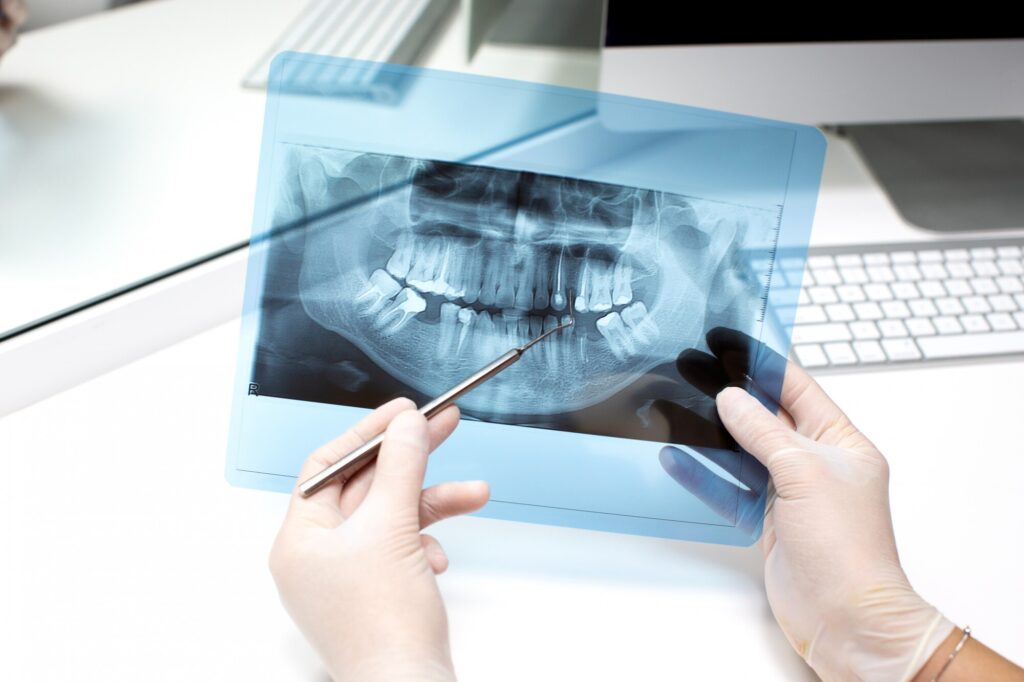
Dentist reviewing a panoramic X-ray, one of the diagnostic services included in CDCP coverage

What Needs Preauthorization?

Many services are covered without approval in advance, but some need preauthorization from the plan before treatment starts. These include crowns and the posts and cores that support them, partial dentures, immediate dentures and overdentures, root canal re-treatment, conscious or deep sedation and general anesthesia, and any service beyond the plan’s frequency limits.

At our clinic, we submit preauthorization requests for you. Most approvals are valid for up to 12 months from the date they’re issued.

How Often the CDCP Covers Common Services

Your CDCP dental coverage also has frequency limits, which are based on rolling periods such as any 12 months. Here are some of the limits for adults (age 17 and older) from the CDCP Dental Benefits Guide:

Service How often it’s covered
Recall (checkup) exam 1 in any 12 months
Complete exam 1 in any 5 years
Scaling (cleaning) Up to 4 units in any 12 months, including root planing
Polishing Half a unit in any 12 months
Fluoride 1 treatment in any 12 months
Panoramic X-ray 1 in any 5 years, up to 3 per lifetime
Crowns Up to 4 in any 10 years, and 1 per tooth in any 8 years
Complete dentures 1 per arch in any 8 years

A unit of scaling is 15 minutes, so 4 units add up to about an hour of cleaning time a year. Extra units may be covered with preauthorization, and children have different limits, such as fluoride once every 6 months up to age 16.

What Isn’t Covered?

Orthodontic services, such as braces or Invisalign, are currently not available under the CDCP. The plan’s exclusions also include cosmetic treatment such as teeth whitening, as well as veneers, implants and implant-related procedures, bridges, mouth guards, and night guards.

If you’re weighing one of these treatments, ask for a written estimate first. Our guide to Invisalign cost in Canada explains how orthodontic treatment is usually paid for.

Already enrolled in the CDCP, or still checking whether you qualify?

Why You Might Still Get a Bill

This is the part that surprises many patients: even with a 0% co-payment, you may still owe something because of how the plan sets its prices.

The CDCP pays according to its own established fees, often called the CDCP fee guide (officially, the CDCP dental benefit grids, published for each province and territory). These fees are set independently of provincial dental association fee guides and are reassessed every year.

Dentists in BC set their own fees, and many practices, including ours, use the BC Dental Association’s suggested fee guide as a reference point. When a clinic’s fee is higher than the CDCP fee, the difference is your responsibility, on top of any co-payment.

Here is the Government of Canada’s own example, for illustration only. A clinic charges $145 for 2 units of scaling (30 minutes of cleaning), and the CDCP fee for that service is $134:

Co-payment level CDCP pays You pay
0% $134.00 $11.00
40% $80.40 $64.60
60% $53.60 $91.40

You may also owe something if:

  • A service isn’t covered by the plan
  • You’ve reached a frequency limit, such as your yearly scaling units
  • A service that needs preauthorization wasn’t approved before treatment
  • You received care before your coverage start date, or during a gap after a missed renewal

The government’s guidance to dental offices is that CDCP patients shouldn’t be asked to pay the full cost upfront, only any amount the plan doesn’t cover. Our guide to root canal cost in BC shows how fee-guide pricing works for one common treatment.

At our clinic, before we start anything beyond a checkup, we work out what the CDCP is expected to cover, what your co-payment level means for you, and what is likely to be left over. Then we put that in writing.

Questions to Ask Before CDCP Treatment

The Government of Canada recommends always asking your provider about any costs the plan won’t cover. These questions help:

  • Is this service covered by the CDCP, and does it need preauthorization?
  • What is your fee, and what is the CDCP fee for the same service?
  • What will my co-payment be at my coverage level?
  • Have I already reached the frequency limit for this service?
  • Is my coverage active on the date of my appointment?

How to Apply for the CDCP

You apply directly with the Government of Canada, not through your dentist. Applications for the 2026–2027 benefit period are open, and there is no fee to apply.

  1. Check your eligibility. Make sure you meet all four conditions above, including the codes on your T4 or T4A slips.
  2. Gather your details. For yourself and each dependant, you’ll need a Social Insurance Number (if available for children), date of birth, full name, home and mailing address, and any dental coverage through a government social program.
  3. Apply online or by phone. Complete the CDCP application through My Service Canada Account or Canada.ca, or call Service Canada at 1-833-537-4342 (8:30 a.m. to 4:30 p.m. local time, Monday to Friday).
  4. Watch for your letter. If you’re enrolled, a letter by mail or email confirms your member ID, coverage start date, and co-payment level. Sun Life also mails a welcome package with your member card.

Your spouse or common-law partner must submit their own application, while your dependent children are included on yours. Be careful of scams: the government warns about messages that ask for personal, banking, or credit card information.

CDCP Renewal: Don’t Let Your Coverage Lapse

Coverage isn’t automatic from year to year. Each benefit period ends on June 30, and you must renew every year to confirm you still qualify. To renew, you and your spouse or common-law partner must have filed last year’s taxes and received your notices of assessment.

The renewal period for 2026–2027 closed on June 1, 2026, and renewals for 2027–2028 open in spring 2027. If you missed the deadline, you can apply again, but care you receive during the gap in coverage won’t be covered or reimbursed.

How to Use Your Canadian Dental Care Plan in BC

Once you’re enrolled, using your coverage at Dentist on Kingsway is straightforward:

  1. Wait for your start date. Only care you receive after your coverage start date is covered, so don’t book treatment before then.
  2. Call us with your member number. Phone 604-558-2442, and we’ll verify your coverage, explain your co-payment level, and get you booked.
  3. Bring your details. Have your CDCP member ID, a piece of identification, your coverage start date, and your co-payment level ready for your first visit.
  4. Review your estimate. Before anything beyond a checkup, we put the expected CDCP payment and your share in writing.
  5. Let us bill the plan. We bill the CDCP directly, so you pay only your co-payment and any remaining balance.

Reception desk at Dentist on Kingsway in Vancouver, where CDCP claims are billed directly

A good place to start is a comprehensive exam and cleaning, which gives us a full picture of your oral health before you plan covered care. Coming in as a family? See our family dentist in Vancouver page.


CDCP vs Private Dental Insurance in BC

Many people searching for dental insurance in BC really want the most affordable way to see a dentist. Here’s a simple way to compare:

  • If you have no access to dental benefits and your adjusted family net income is under $90,000, start by checking whether you qualify for the CDCP.
  • If you have benefits through work, you generally won’t qualify for the CDCP, even if your work plan covers less.
  • If your income is $90,000 or more, private dental insurance or an extended health and dental plan may be worth comparing.

Keep in mind that buying a private dental plan counts as having access to dental coverage, so it ends your CDCP eligibility. If you qualify for the CDCP, weigh that before you buy.

Whichever coverage you have, our team can help you understand your benefits before treatment. To check how the CDCP applies to your care, call Dentist on Kingsway at (604) 558-2442 or book an appointment online.

Frequently Asked Questions

Does Dentist on Kingsway accept the CDCP?

Yes. We accept the Canadian Dental Care Plan and bill it directly, so you pay only whatever the plan doesn’t cover. Before we start anything beyond a checkup, we explain what the CDCP is expected to pay and put your estimate in writing.

Why do I owe money if my co-payment is 0%?

The CDCP pays according to its own fee schedule, which is set independently of the BC Dental Association’s suggested fee guide. If a clinic’s fee is higher than the CDCP fee, or a service isn’t covered, you pay the difference.

Does the CDCP cover braces or Invisalign?

No. Orthodontic services are currently not available under the CDCP. Cosmetic treatments such as whitening and veneers are excluded too.

Can I have the CDCP and private dental insurance?

Generally, no. Access to private dental coverage, even through a spouse or a health spending account, makes you ineligible whether or not you use it. Retirees who opted out of pension dental coverage before December 11, 2023, and can’t opt back in are the exception.

Does MSP cover dental in BC?

Generally, no. BC’s Medical Services Plan lists dental services among the things it doesn’t cover, apart from limited benefits such as dental and oral surgery performed in a hospital. Routine care such as checkups, cleanings, and fillings is paid through dental insurance, a program like the CDCP, or out of pocket.

Can my child use the CDCP and the BC Healthy Kids Program?

Yes, the two can be combined. Healthy Kids is for children in families eligible for MSP supplementary benefits. The CDCP pays first, and Healthy Kids may cover some of the remaining cost.

How do I renew the Canadian Dental Care Plan?

You renew every year during the spring renewal period, for example through My Service Canada Account. If you miss the deadline, you can apply again, but care received during the gap isn’t covered.

Does the CDCP cover dentures?

Yes. Complete and partial dentures are covered, along with relines, rebases, and repairs. Partial dentures, immediate dentures, and overdentures need preauthorization, and standard complete dentures are covered once per arch in any 8 years.

On this page

Book Your Visit

Have a question about this topic? Our team is happy to help.

or call (604) 558-2442

Related guides

Scroll to Top